Distribution Alone Is Not a Moat: The Growth Playbook for the GPT Ads Era
Meta, YouTube, Google and ChatGPT do different jobs in a company’s growth system. AI is making each one easier to operate and easier for competitors to copy.
“Distribution to me is the only moat,” Matt Swulinski says in an August 2026 20Growth interview.
The claim matters because distribution does more than deliver customers. It exposes a product to demand, tests which promises work and can accelerate learning. Yet access to a paid platform is available to rivals too. Meta auctions, Google search placements and ChatGPT ad inventory can help a company reach customers; the same platforms and increasingly accessible AI tools serve its competitors.
Swulinski built growth at Wispr Flow, worked at Superhuman and now leads growth at Viktor. His interview offers practical advice on paid media, e-commerce creative, conversion signals, referral timing and agentic campaign workflows. This article treats those recommendations and company examples as operating accounts from the people involved, not independent performance benchmarks. It uses the question behind “only moat” to map what channels do, what growth teams can learn and which resulting assets may endure.
Distribution is essential. Rented access to a platform rarely creates a durable advantage on its own. The strategic question is what remains after a competitor can buy similar reach and copy the campaign.
That question changes how we should map go-to-market in the AI era. Labels such as social, search, programmatic and lifecycle describe where media is bought or which interface a team operates. They say very little about the job each channel performs in a company’s growth.
The earlier essays in The changing commercial web ask how agents affect trust, control, and the customer relationship. Here the question is what a company can build from those changes that remains valuable when competitors obtain similar tools. A more useful growth map begins with purpose.
The Channel Map Marketing Has Been Missing
Prospective customers are not all in the same state. Some have not yet named the problem. Others know the category and are comparing products. Some have signed up but have not experienced enough value to pay, return or tell a colleague. Others would rather use a product inside a workflow they already trust than visit another destination.
Calling these routes “social”, “search” and “programmatic” groups them by media supply. The company needs to group them by customer state.
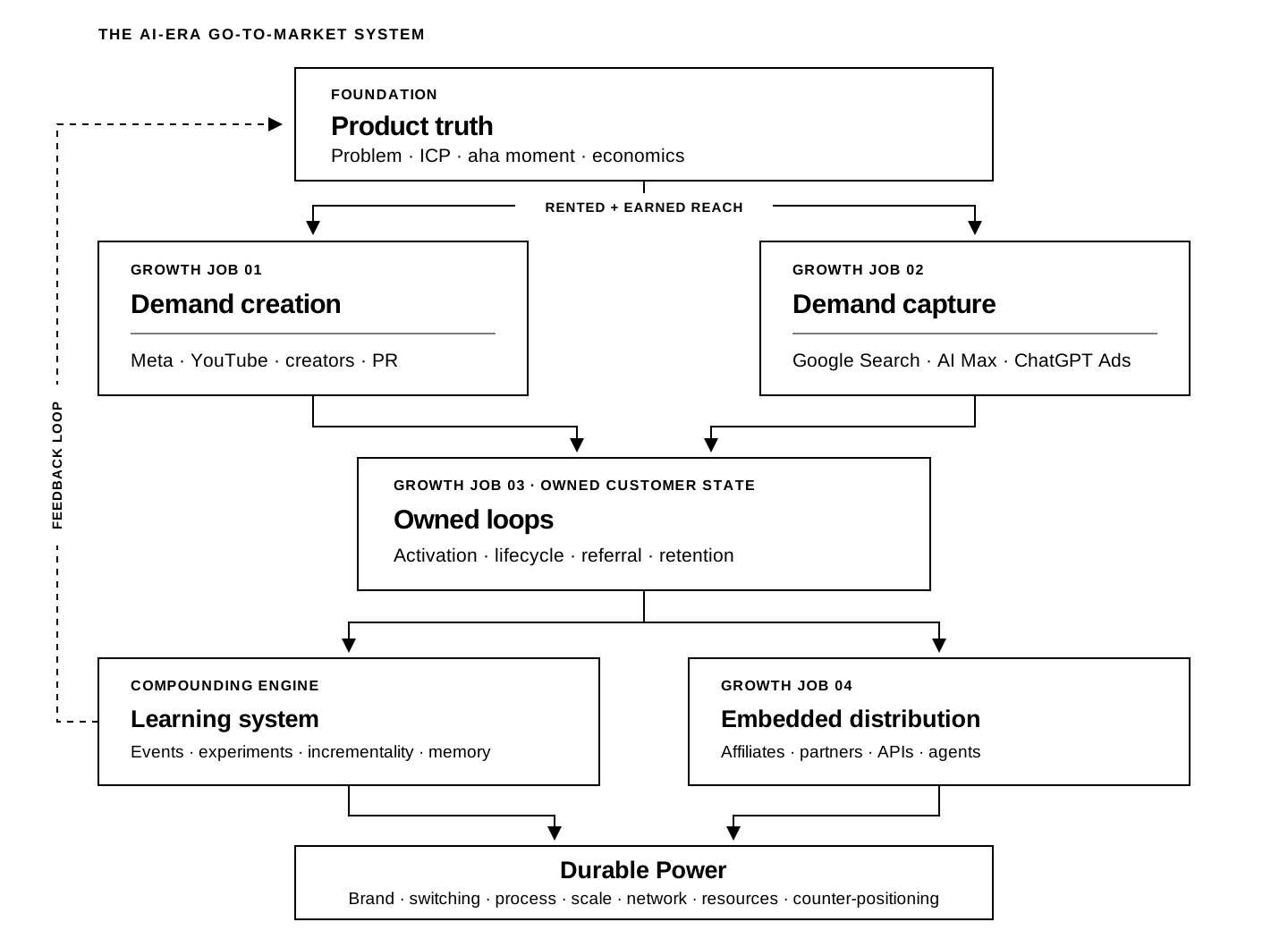
The map separates five operating jobs from one strategic test:
| Growth job | Customer state | Typical channels | The result it should create |
|---|---|---|---|
| Demand creation | The problem, category or brand is not yet salient | Meta, YouTube, creators, PR, events | Attention, memory, education and future preference |
| Demand capture | A need is active and the customer is researching or choosing | Google Search, AI Max, ChatGPT Ads, comparison and review surfaces | A relevant transition into evaluation or product use |
| Owned loops | The prospect or user has entered the company’s experience | Onboarding, product, email, push, sales, referral, community | Experienced value, conversion, repetition and advocacy |
| Embedded distribution | The customer is already working or deciding somewhere else | Affiliates, integrations, marketplaces, APIs, agents, service partners | The product becomes available inside an existing workflow |
| Learning system | The company must decide what to repeat, change or stop | Events, warehouse data, experiments, research, creative memory | Better product, proposition, allocation and decisions |
| Durable Power | Competitors try to copy the successful playbook | Business model, product state, cost structure, brand, network, process | Persistent advantage protected by a barrier |
The same platform can perform more than one job. YouTube may create demand through a patient product demonstration and capture it through a review watched during evaluation. Meta can build memory, retarget active prospects or reactivate an existing customer. The category describes the purpose of the investment, not an immutable property of the channel.
That distinction makes the map useful over time. Platforms will merge, agents will mediate more decisions and new ad formats will appear. A company will still need to create demand, capture active intent, deliver value, enter workflows and learn.
Demand Creation: Make the Problem and Product Memorable
Demand creation reaches people before they have formed a neat query.
Meta is strong here because a feed can introduce a product while someone is doing something else. The creative has to make the problem recognisable quickly. A useful ad may show the frustration, demonstrate the changed workflow and give the product a shape the audience can remember.
YouTube gives that story more time. Swulinski describes using short educational videos for Wispr Flow, then pairing them with non-brand Search and Performance Max. Meta’s interruption and YouTube’s explanation prepared the ground; Search captured people once the need became explicit.
Creators, PR and customer evidence also sit in this layer. Their value reaches beyond immediate referral traffic. A detailed review can educate a buyer, supply a future AI answer with corroborating evidence and reduce uncertainty when the brand appears again.
This is where a narrow performance lens causes damage. If YouTube is assessed only on the last click, an educational video that creates a later branded search looks unproductive. If PR is judged only by referral sessions, an authoritative source that influences an AI-generated consideration set disappears from the report.
Demand creation still needs measurement. It needs measurement suited to memory and future behaviour: controlled reach, search lift, direct demand, assisted activation, cohort quality and, at sufficient scale, experiments that compare exposed and unexposed groups.
Demand Capture: Appear When Intent Becomes a Decision
Google Search has owned this job for two decades. A query declares a need; the auction offers a route toward satisfying it.
AI is making that declaration longer and less tidy. Google’s AI Max for Search combines advertiser inputs such as keywords, creative and website content with broader intent signals. It can expand matching, adapt text and choose a relevant landing page. In April 2026, Google announced AI Brief in closed beta, allowing advertisers to steer messaging, matching and audience guidance in richer language. In September, Google announced additional language support and a new reporting feature, with availability details still to come.
Keywords have not vanished. They have become one input to a model that interprets a larger field of intent.
ChatGPT Ads takes the shift further. The official product now supports campaign management, product feeds, audience targeting, measurement and conversion optimisation through the OpenAI Ads developer platform. Its most revealing planning object is the context hint.
OpenAI tells advertisers to describe products, use cases or needs that creative and landing pages do not fully express. These are advertiser hypotheses about relevance; they are not transcripts of a customer’s conversation or verified statements of that person’s goal. Context hints are not exact-match keywords, and they do not guarantee that a particular conversation will trigger an ad.
The unit of planning changes:
Keyword cluster
    ↓
Need state + constraints + decision stage + credible next action
An advertiser might once have targeted AI meeting assistant. A conversational hypothesis can be more precise: a small consultancy needs accurate action items and client-safe summaries, but cannot add a recording bot to the call.
That richer intent is commercially valuable because the user may already have explored the problem, narrowed the constraints and reached a moment of consideration inside the conversation. It also creates a harder relevance test. The ad, landing page and product experience must continue the task the user was trying to complete.
ChatGPT Ads should therefore begin as a controlled demand-capture experiment. Public benchmarks are immature. The first question is whether a placement beside a specific, high-intent task produces incremental activated and retained customers at acceptable contribution-margin payback. It is too early to ask how much of the Search budget should move permanently.
Owned Loops: Turn Acquisition Into Experienced Value
Paid channels can deliver a visitor. They cannot experience the product on the visitor’s behalf.
For an AI product, the decisive event is often the first successful task: a meeting converted into accurate actions, a workflow completed, a useful asset produced, a complex decision made easier. A sign-up records entry into the product; it does not show that this useful outcome occurred.
The company needs an event ladder that reflects this reality:
Qualified visit
  → account or lead
  → first successful task
  → repeated successful task
  → paid conversion
  → retained gross profit
This ladder should govern channel optimisation. If Meta, Google or ChatGPT learns from registrations while most registrants fail to complete the first task, the platform will find more cheap failures. As volume and data quality improve, the optimisation signal should move closer to experienced and retained value.
In his account, Swulinski applies the same logic to paywalls and referrals. He recommends asking for payment after a user encounters the product’s “magic moment” and testing referral prompts when value is fresh or additional capacity becomes useful. At Superhuman, the reward was subscription time; at Wispr, the prompt could appear near a word limit; at Viktor, usage credits and revenue share connect the incentive to the product’s economics.
The transferable hypothesis is about timing: a referral prompt may work better when it meets an active motivation. Test that against other moments, then measure whether referred users activate and retain, rather than counting links sent or accounts created.
AI unit economics make this discipline sharper. Usage credits carry inference and service costs. Revenue LTV can flatter a model with expensive delivery. Acquisition should be evaluated against retained gross profit or contribution margin after model inference, multimodal processing, support and trial costs. That tests the economics; The Empowerment Imperative asks what separate evidence would show that the experience served the customer.
Embedded Distribution: Move Into the Workflow
The next distribution contest will not always send a person to a website.
An affiliate may recommend a product inside trusted content. An integration may make the product available inside an existing system. A buying agent may select and call a capability without the customer opening the supplier’s interface. Distribution moves closer to the place where the decision or work already happens.
Ramp describes this principle directly in its Technology Partner Program: good business software brings the action into the workflow where the decision is being made. Its partner routes include referrals, integrations and embedded finance functionality.
This is more than a channel extension. It changes the unit of distribution from a visit to a completed action.
We explored the broader consequence in Marketing in the Agent-Owned Web: a product can continue providing essential data and execution while another agent owns the customer context and chooses which capability to invoke. The company may gain distribution while another system gains influence over selection and task continuity. It may still retain the transaction, fulfilment, support, and renewal relationship. Name which control is changing before treating it as a loss of the whole customer relationship.
Embedded distribution therefore needs commercial and strategic measurement. The team must know who owns permissions, customer data, support, renewal, attribution and the right to offer the next product. Volume without relationship ownership can create a large dependency disguised as growth.
The E-Commerce Lesson for AI Software
Swulinski’s larger operating idea is that SaaS should borrow e-commerce’s performance discipline.
In commerce, spend is expected to connect to a purchase or another meaningful event. Creative operates as a portfolio. Product demonstrations, creators, offers, landing pages and channels are tested together. The team does not wait for an abstract brand foundation to finish before exposing a proposition to demand.
Applied carefully, this gives AI software a faster learning loop.
Paid traffic can test whether a cold audience understands the promise. Creative can reveal which use cases travel. Landing pages can expose whether the message survives contact with the product. Different cohorts can show where activation, retention and gross profit diverge.
Paid media does not prove product-market fit. It can validate a narrower chain:
Audience
  → message
  → visit
  → activation
  → retained economics
A company is ready to buy this learning when it has a coherent promise, a usable first-run experience, an observable value event and enough economic room to run a real test. Starting earlier without those foundations trains the platforms on noise.
The creative-volume lesson also needs care. Swulinski says a company spending $100,000 a month on Meta may need 400–500 new creatives to avoid a plateau. That is an account-specific operating view, not a universal benchmark.
The useful principle is conceptual diversity. A portfolio should test different problems, customers, proofs, objections and frames. Five hundred colour, crop and headline variations may enlarge the asset count without teaching the company anything new.
AI can assist recombination, localisation, resizing and script variations. The scarce question is which customer truth deserves 50 variations. The Anti-Slop Marketing Stack connects that choice to brand memory, cultural context and creative judgment. A portfolio needs distinct hypotheses before it needs more assets.
The Cannes cases show how far those hypotheses can reach: a banking service available through another channel, participation inside an app, or an offer whose timing carries the idea. Creative variety can change the experience itself as well as the message advertising it.
How AI Changes the Control Panel
Three paid systems now reveal a common direction.
| Platform | Earlier control surface | Emerging control surface | Model’s growing role | Marketer’s enduring responsibility |
|---|---|---|---|---|
| Meta | Audience segments, placement and bids | Broad eligibility, creative portfolio and outcome signal | Retrieval, audience matching, budget, placement and variation | Original hypotheses, proof, brand safety and downstream value |
| Keywords, match types, text ads and bids | Intent envelope, site/feed context, business guidance and outcome goal | Query expansion, asset adaptation, URL selection and bidding | Product truth, exclusions, page quality and conversion value | |
| ChatGPT Ads | No direct predecessor; closest to contextual and high-intent search | Need state, contextual fit, audience, creative, destination and outcome | Conversation-context matching and click/conversion optimisation | Helpful relevance, credible next action, first-party evidence and trust |
Meta’s Andromeda retrieval system narrows tens of millions of eligible ads to a few thousand candidates before later ranking. Meta says it learns interactions among people, interests, products, services and ad features. Advantage+ automates audience, budget, placement and creative functions around that system.
This supports a precise version of the popular phrase “creative is the targeting.” Creative has become an important way to tell the system which problem, person and use case an ad may fit. The system still uses much more than creative.
Across all three platforms, detailed manual control gives way to inputs and boundaries:
- the customer problem the company can solve;
- claims and evidence the brand can defend;
- creative expressions of distinct hypotheses;
- product and landing-page information;
- events that represent real value;
- budgets, audiences, exclusions and risk controls.
The interface becomes simpler while the judgment behind the inputs becomes more demanding.
The allocation decision must distinguish a platform-attributed conversion from an incremental customer outcome. Who Owns the Pixel? explains the measurement boundary and the separate paid, discovery, and first-party records. Here the consequence is economic: optimise and allocate against a signal that is close enough to retained value to justify the spend.
Bidding and measurement research connects attribution with incrementality. Faster optimisation increases the cost of choosing a weak proxy, because a system can become efficient at finding conversions that do little for contribution margin.
The same caution applies to AI visibility. Pew Research Center found that users clicked a traditional result in 8% of observed Google visits with an AI summary, compared with 15% without one. Only 1% clicked a source inside the summary. Adobe Analytics, however, found that the smaller flow of AI-referred retail traffic in its data stayed longer and viewed more pages than other traffic, while its conversion deficit narrowed.
AI discovery can absorb clicks and still influence choice. Teams need three measures: presence in the consideration set, qualified transition to the owned experience and incremental retained value.
Growth Becomes Power Only When a Barrier Appears
This brings us back to the word moat.
Hamilton Helmer defines Power as the conditions that create the potential for persistent differential returns. A successful campaign creates a benefit. Power requires a benefit and a barrier.
| Power | How go-to-market may contribute | The common false positive |
|---|---|---|
| Scale Economies | Volume structurally lowers acquisition, inference, fulfilment or production cost | Spending more on Meta or generating more assets with the same public tools |
| Network Economies | Each additional participant makes the product more valuable to existing participants | Calling word of mouth or a referral programme a network effect |
| Counter-Positioning | The challenger uses a model an incumbent cannot copy without damaging its existing business | A lower price, a better interface or an “AI-native” label |
| Switching Costs | Workflow state, permissions, history, integrations and learned preferences accumulate through use | Making export painful or onboarding long |
| Branding | A trusted name reduces uncertainty and changes willingness to choose or pay | A temporary burst of paid awareness |
| Cornered Resource | The company controls a valuable and scarce data right, supply route, talent base or exclusive relationship | Data that customers own and every competitor can also collect |
| Process Power | A socially embedded system learns and executes better through years of accumulated practice | Buying an agent tool or automating one broken process |
The practical test has four questions:
- What economic or customer benefit does the capability create?
- What prevents a competitor from copying or neutralising it?
- Why should the benefit persist when platforms and models change?
- Does the company own the asset, or rent it from a channel?
Paid distribution may fail this test and still be indispensable. Its strategic role is to help the company discover, build and compound the assets that pass.
When a Growth Proposition Can Resist Incumbent Copying
Ramp’s growth story, as described by its founders and in company accounts, begins with an economic contradiction.
Many card-and-rewards businesses earn transaction revenue as customers spend, and rewards can encourage further use. Ramp built its proposition around helping companies spend less and removing finance work. An incumbent can copy a feature. Copying the saving promise all the way down may threaten the incumbent’s profit pool.
That is counter-positioning. Not Boring’s recent analysis uses Ramp as a clean example.
The product then gave the proposition substance. Ramp cofounder Eric Glyman told McKinsey that the company chose to build its own expense software in 2020 rather than integrate with established providers. The decision cost growth and revenue for a period. Glyman says the resulting product became ten times better and set off a rapid growth phase. In the same interview, he attributed roughly one-third of new customers to word of mouth.
The referrals carried a real contrast: people did not want to return to the old workflow when they changed employers. Product experience created the story; distribution moved it.
Base Power offers a second illustration, as CEO Zach Dell describes the model in an interview.
Dell describes a residential battery market built around a high-margin upfront sale. A slightly cheaper battery could invite incumbents to copy the product and cut price. Base changes the transaction: “We don’t sell batteries. We sell electricity.” The company installs and owns the battery, uses it as grid infrastructure and offers the household cheaper electricity and backup power for a fraction of the upfront purchase price.
That model could create a counter-position: an established battery seller might have to replace its existing revenue model to follow. The claim depends on the incumbent’s actual economics, so the interview illustrates the strategic logic rather than proving the barrier exists.
Time is not permanence. Another startup may copy the model even if an incumbent cannot. Any durable advantage would depend on what Base can build during that window: lower landed costs, vertical integration, an installed fleet, utility relationships and an operating process that improves with use. Counter-positioning may open the space; scale or process could help defend it.
These are founder and company accounts, not independent evidence of persistent returns. They illustrate how a distribution-led proposition might connect to strategy; neither example alone proves that a durable Power has formed.
That is the relationship growth teams should seek. A channel carries a proposition. A growth system learns where it works. Company strategy turns the learning into an advantage the next advertiser cannot buy from the same platform.
The AI-Native Growth Team Is a Learning System
Swulinski’s most revealing AI example is not an ad generator. It is a newsletter sponsorship workflow.
The system detected an inbound proposal, collected rates, researched the audience and prepared negotiation. A human approved the partner. The system then ingested the contract and cost, created copy and tracking links, sent the materials, collected performance and recommended whether to renew. Historical results informed the next cycle.
That workflow has what most marketing chatbots lack:
- a bounded commercial job;
- persistent state;
- explicit decision rules;
- feedback from outcomes;
- defined human approvals;
- memory that changes future execution.
The model writing the email is the least defensible part. The accumulated partner history, performance logic, exception handling and organisational habit may become difficult to reproduce.
This is the more credible version of the “smaller AI marketing team” argument. Routine interface work compresses. The remaining work moves toward customer observation, hypothesis quality, creative judgment, event design, causal measurement, workflow architecture, risk and authority.
An agent can draft, monitor, route, calculate and recommend. A company still needs a person accountable for the budget, claim, contract, experiment and exception. Faster execution increases the value of good judgment because a weak decision now scales instantly.
A 90-Day Operating Plan
Use this as an illustrative cadence for setting up and reviewing the work. The required data volume, customer cycle, and outcome lag determine when a test can answer its question. Ninety days may establish a useful operating process without establishing retained value or causal lift.
Days 0–15: establish product and measurement truth
- Define the first successful task, repeat-use signal, paid conversion and retained gross-profit event.
- Include model inference, image/audio/video processing, trial-credit, support, and other variable costs in acquisition economics.
- Reconcile platform events with first-party customer and revenue records.
- Choose three ideal customer profile (ICP) and use-case hypotheses, each with a specific proof requirement.
- Record the channel baseline and known attribution overlap.
Decision gate: pause scale if the team cannot distinguish a registration from successful use or revenue from contribution margin.
Days 16–45: test creation and capture together
- Test materially different problems, proofs and use cases on Meta.
- Use YouTube when the product requires demonstration or category education.
- Test declared and expanded intent in Google; preserve exclusions and brand controls.
- Launch a small ChatGPT Ads experiment around three to five specific need states.
- Carry the same promise through creative, landing experience and first product task.
Decision gate: a high click rate with weak successful use indicates a broken promise, not a winning ad.
Days 46–75: add owned and embedded loops
- Test referral prompts after the first success, after repeated value and near a meaningful limit.
- Add one affiliate or integration pilot with clear economics, fraud rules and customer ownership.
- Build an evidence cluster for each priority use case: original explanation, customer proof, independent review and useful demonstration.
- Automate one bounded workflow with human authority points and a durable result log.
Decision gate: if people repair the agent’s output outside the system, no learning loop exists. Feed the correction back or stop automating the task.
Days 76–90: measure lift and audit for Power
- Before the test, define the primary retained-value outcome, exposure window, analysis window, and decision threshold. Use a randomised holdout where feasible. If considering a matched-market design, assess scale, comparability, confounding, and the pre-test baseline; it is not an automatic substitute. Extend the observation period or report the result as inconclusive when the design cannot support the claim.
- Compare incremental outcomes with platform-attributed conversions, accounting for lag and overlap across channels.
- Record which channel insights changed product, onboarding, price or ICP choice.
- Apply the benefit, barrier, persistence and ownership test to every claimed moat.
- Select one compounding asset to deepen over the next two quarters.
Decision gate: scale a channel because it creates incremental retained value. Invest strategically when it also strengthens something the company owns.
Rent the Reach. Build What Compounds.
Swulinski is right about the urgency of distribution. A remarkable product that cannot reach demand remains a private achievement. AI companies should learn from e-commerce’s speed, creative breadth and economic discipline. They should test Meta, YouTube, Google and ChatGPT according to the customer state each one can change.
The stronger conclusion begins where the “only moat” claim ends.
AI is lowering the cost of campaign production, media operation and workflow execution. Every reduction in cost removes a small barrier competitors once faced. Access becomes abundant. Imitation accelerates.
The growth team’s job expands. It must create and capture demand, then turn that demand into an owned learning system: better product truth, better outcome data, deeper customer state, more credible evidence, stronger relationships and a process that improves with use.
Meta can rent a company reach. Google can rent it access to search intent. ChatGPT can place an ad in a considered task. These channels can help a company build product learning, credible evidence, customer relationships and operating capabilities. At the next investment review, name the asset, its customer or economic benefit, the barrier a competitor would face, and who controls it. Choose which asset to deepen, and test whether the barrier persists. That is the step from effective distribution to a defensible business.
Reference Reading
- Matt Swulinski: How to Build a $100M Growth Engine, 20Growth, 15 August 2026
- ChatGPT Ads developer documentation
- Targeting and context hints for ChatGPT Ads
- Meta Andromeda advertising retrieval system
- AI Max for Google Search campaigns
- Google users are less likely to click when an AI summary appears, Pew Research Center
- The explosive rise of generative AI referral traffic, Adobe Digital Insights
- Inside Ramp’s vision for zero-touch finance, McKinsey
- An Ode to Counter-Positioning, Not Boring
- Building a Power Company for the Next 50 Years, Zach Dell interview
- 7 Powers synopsis, Hamilton Helmer
- Who Owns the Pixel? ChatGPT and the Repricing of Advertising, Dessi Georgieva
- The Answer Independence Paradox, Dessi Georgieva
Publication history
Originally published by Performics Labs.