Jev as Ad Tech's System 1: Fast Decisions, Slow Learning
How marketing agents can use Jev to classify search terms, tag creative, route leads, process customer feedback and verify proposed actions while code and people keep control.
Marketing systems repeatedly classify language before it can affect a campaign: a search query becomes an intent label, an ad becomes a set of creative attributes, a lead becomes a queue, and an agent proposal becomes a risk category. These decisions are manageable one at a time. Applying them consistently across large volumes is harder.
A reasoning model can plan the work, inspect examples, propose a taxonomy and explain patterns. Repeating a bounded judgment thousands of times, however, can be an awkward use of a general-purpose model. The output must also be checked and converted into a form software can use.
Jev, TypeSafe’s first “System One” model, is designed for this decision layer. Given a state and one or more typed questions, it returns structured answers and probability information. It is built for classification and scoring, not campaign planning or finished copy. TypeSafe’s current model documentation distinguishes its versioned models and describes the supported inputs.
The question for marketing is not whether Jev is a better general model. It is whether a specialised decision model can handle a specific, repeated task at an acceptable error rate and total cost.
I see two possible roles for it in an agentic system: classify high-volume marketing language into bounded labels, and check a proposed action against its evidence and stated rules. Classification is a direct use of the documented interface. Using Jev as an independent verifier is an architectural proposal that still needs workflow-specific evaluation. In either role, code retains control of permissions and execution.
This separation matters because digital advertising already turns language into operational categories: queries become intents, assets become creative attributes, pages become topics, leads become routes and proposed actions become risk classes. Faster classification is useful only if we keep it separate from causation, authorization and the final decision.
The Work Marketing Agents Cannot Do Economically
Marketing organisations have accumulated a large reserve of operational “dark data”: information that exists but is too unstructured or numerous to use consistently.
It includes search terms, call notes, ad comments, creative transcripts, product titles, customer reviews, support tickets, landing pages, campaign briefs, compliance policies, CRM records and traces left by agents. A person can interpret any one record. The challenge is applying the same definitions across many records quickly enough to inform the work.
The usual options each leave a gap.
- Deterministic code is dependable when the condition is explicit. It can enforce a budget cap or detect an exact phrase, but it cannot reliably infer whether “shoes for standing all shift” expresses a comfort-led purchase need.
- Supervised classifiers are efficient when the task is stable and labelled data is plentiful. Every new market, taxonomy or business question, however, becomes another training and maintenance problem.
- Generative language models can interpret ambiguous records, but open-ended generation is excessive for a closed decision. Their prose or JSON must be validated, confidence is often poorly defined, and repeated calls consume reasoning capacity without adding much value.
- Human judgment handles the remainder, creating queues and inconsistent taxonomies.
Jev occupies the space between a rule and a conversation. Its request contains a state and one or more questions. Its answer uses three primitives:
| Primitive | What it returns | Marketing example |
|---|---|---|
Choice | Selects an option and returns probabilities and confidence | Is this query purchase, research, support, recruitment or irrelevant? |
Score | Returns a score across ordered levels, their probabilities and confidence | How well does this advert match its landing page? |
Noul | Returns the probability that a yes/no statement is true | Does this copy appear to make an unsupported health claim? |
The distinction sounds narrow. Operationally, it is useful. A typed result can become a warehouse column, a queue rule, a feature for another model or evidence considered by an agent. No one needs to scrape a conclusion from a paragraph.
Two Possible Roles Inside the Agentic Stack
In a recent interview with Latent Space, Jev creator Diogo Almeida describes System One models as machine-native intelligence: models built for code to consume, often many times within a larger process. This is TypeSafe’s framing of its product category. I use it here as an architectural distinction between repeated bounded decisions and slower planning, not as a claim that machines reproduce human cognition.
For marketing, the architecture might look like this:
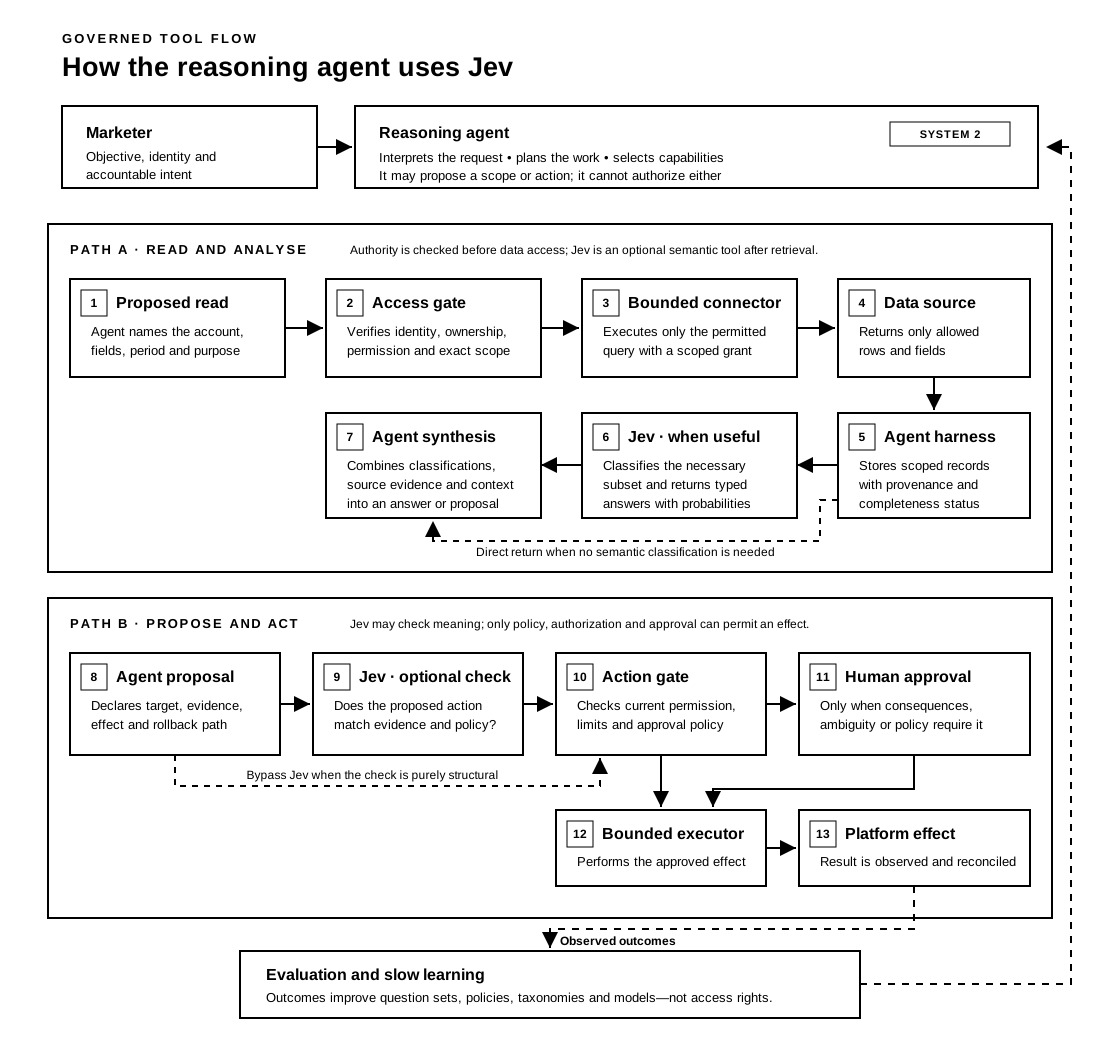
This is a tool loop, not one mandatory pipeline. On the read path, the reasoning agent proposes the account, fields, period and purpose it needs. An authoritative access gate verifies the user’s identity, tenant, ownership and permissions. Only then does a bounded connector query the data platform. The connector returns the permitted rows and fields to the agent harness with their provenance and completeness status.
The agent may then choose Jev, just as it might choose a SQL tool, calculator or forecasting model. It sends Jev only the subset needed for the semantic decision. Jev converts that material into a compact decision surface: intent, topic, stage, fit, risk, urgency or another bounded variable. Its answer returns to the reasoning agent for synthesis. If the task does not require classification, the data can bypass Jev entirely.
On the action path, the reasoning agent first proposes an effect. Jev can independently evaluate whether that proposal matches the evidence and the natural-language policy supplied in the state. That result is evidence, not authorization. A deterministic action gate checks current permissions, target identity, limits and approval requirements before a bounded executor can change the platform.
The authority boundary therefore appears twice: before a read, to control which data may enter the agent’s context; and before a write, to control which real-world effect may occur. A person’s approval is added when the consequence, ambiguity or policy requires accountable judgment.
Here, “System 2” is an architectural shorthand for the reasoning and slower evaluation functions around Jev, not a claim that machine components reproduce human dual-process cognition. It does not need to be one permanent second model. The reasoning agent synthesises the current task; the evaluation loop uses observed outcomes to improve later question sets, taxonomies, policies and models. Those outcomes never create new access rights by themselves.
The Digital-Marketing Decision Map
A useful first filter asks four questions:
- Is the necessary input mostly textual, or can other observations be supplied with a trustworthy description?
- Is the answer space bounded, such as a defined category, yes/no decision, or score with explicit anchors?
- Does the decision recur often enough for a stable contract and evaluation set to be useful?
- Can a mistaken label be contained through review, limited downstream effects, or recovery?
These characteristics make a task a candidate for evaluation, not a proven fit. The map below is a set of hypotheses for teams to test on their own labelled records. It does not rank Jev’s performance in advertising tasks.
| Area | Candidate decision | Why test it | Main caveat |
|---|---|---|---|
| Paid search | Query intent, irrelevance, negative-keyword candidates, landing-page fit | Repeated text judgments can be compared with campaign scope and human labels | A label alone does not justify excluding a query; intent and business value can diverge |
| Paid social | Creative hook, proof type, funnel stage, claim risk | Structured tags can make a creative portfolio easier to analyze | Image and video observations may come from separate systems and need evidence tracking |
| CRM and sales | Lead need, stage, fit and route | Semantic triage can produce reviewable queue suggestions | Identity, consent, ownership and eligibility belong in authoritative systems |
| Voice of customer | Review, survey, ticket and comment themes | Consistent labels can help teams retrieve examples across large text collections | Feedback is a selected sample, not a representative picture of all customers |
| SEO and content operations | Page type, search intent, duplication risk, internal-link relevance | Bounded text decisions can be checked against editorial rules | A relevance label is not evidence that a page will rank or drive traffic |
| Email operations | Message intent, offer type, complaint risk, response routing | Classification may help route messages for review | Consent and identity remain outside the model |
| AI-search monitoring | Citation type, brand framing, answer intent, claim presence | Labels may make observations comparable over time | Measurement methods and answer sources need their own validation |
| Agent verification | Action-to-evidence fit, ambiguity and policy alignment | A separate semantic check may surface mismatches before execution | A second model can share blind spots and cannot grant permission |
| Programmatic media | Pre-auction page classification and cached suitability features | Upstream classification can provide features to a bidder | Latency, freshness and specialist prediction constrain use; test before production |
| Autonomous bidding | Direct bid or budget decision | This is a distinct decision problem | Keep arithmetic, outcome prediction, constraints and causal learning in appropriate systems |
| Strategy and creative writing | Positioning or finished work | These tasks may supply context for classification | They require synthesis and generation, rather than repeated bounded judgments |
A classification can supply a feature to a bid model; that does not make Jev the bidder. It can label social proof in a successful advert; that does not show social proof caused the result.
Build Jev as a Tool, Not a Prompt
An agent should not compose a fresh Jev request every time it encounters a classification problem. Give it a governed tool with a stable contract:
classify_marketing_records(
  records,
  question_set_id,
  taxonomy_version,
  model_version,
  action_policy_id
)
The wrapper around Jev should own the operational detail:
- a pinned model version;
- approved question sets and label definitions;
- batching, rate limits, retry behaviour and timeouts;
- schema and business-rule validation;
- confidence thresholds and review queues;
- input hashes, timestamps and provenance;
- quality-control samples and retention rules;
- separation between classification and action.
The stored result should preserve more than the winning label. This is an illustrative record normalized by a proposed marketing wrapper, not a raw Jev SDK response:
{
  "record_id": "q_104291",
  "question_set_id": "paid_search_triage_v3",
  "taxonomy_version": "intent_2026_09",
  "model": "jev-1.13.0",
  "answers": {
    "intent": {
      "value": "purchase",
      "probabilities": {
        "purchase": 0.82,
        "research": 0.13,
        "support": 0.02,
        "irrelevant": 0.03
      }
    },
    "safe_to_exclude": {
      "value": false,
      "probability": 0.06
    }
  },
  "action_policy": "negative_keywords_shadow_v2",
  "route": "develop",
  "input_hash": "sha256:…"
}
The probabilities matter because a result with purchase: 0.82 and research: 0.13 contains more operational information than the label purchase. The system can compare uncertainty, defer borderline records and detect a shift after a model or taxonomy update.
Ask parallel, atomic questions
TypeSafe recommends questions that a knowledgeable person could answer as a fast, single semantic judgment. Its current question guidance says to split judgments that require extended reasoning or combine independent factors. The interview describes a useful pattern for large jobs: put records with stable IDs into one state, then ask the same independent questions about each ID. The state is ingested once and the decisions can run in parallel. The sketch below illustrates the shared state and stable IDs; it is not a TypeSafe API request body. Use the current SDK or API documentation for the exact request schema.
{
  "state": {
    "records": {
      "q_101": {
        "search_term": "best trail shoes for wide feet",
        "campaign": "Trail Running",
        "landing_page": "Men's waterproof trail collection"
      },
      "q_102": {
        "search_term": "running shoe customer service number",
        "campaign": "Trail Running",
        "landing_page": "Men's waterproof trail collection"
      }
    }
  },
  "questions": [
    "Classify the search intent of q_101",
    "Classify the search intent of q_102",
    "Assess landing-page match for q_101",
    "Assess landing-page match for q_102"
  ]
}
Parallelism does not justify an unlimited state. TypeSafe’s state guidance warns that irrelevant information can reduce accuracy. Batch records that genuinely share context, and test the point at which a larger state harms quality.
Playbook One: Paid-Search Triage
Paid-search query analysis is a useful first pilot candidate. It is text-based and can be run in shadow mode before any platform change. Its actual value and error tolerance still need to be established on labelled account data.
The agent first retrieves an agreed period of search-term data and enriches each term with campaign, ad group, matched keyword, landing-page summary and a coarse performance bucket. It then calls the governed Jev tool with three separate questions:
The following is an HTTP request-shaped example using TypeSafe’s documented fields. The label descriptions and outputs are illustrative; calibrate them on account data before using them in a workflow. The Choice, Score, and Noul references define the current request and response fields.
{
  "model": "jev-1.13.0",
  "state": {
    "search_term": "jobs delivering running shoes",
    "campaign": "Running Shoes | Non-brand",
    "ad_group": "Running Shoe Delivery",
    "matched_keyword": "running shoes delivery",
    "landing_page_summary": "E-commerce category for running shoes with next-day delivery",
    "performance_bucket": "12 clicks, no qualified session"
  },
  "questions": {
    "intent": {
      "type": "choice",
      "instructions": "What is the primary intent expressed by the search term?",
      "criteria": {
        "buyer": "The person is looking to buy running shoes or arrange delivery.",
        "researcher": "The person is comparing or learning about running shoes.",
        "competitor": "The person is seeking a competing brand or retailer.",
        "recruitment": "The person is looking for a job or employment information.",
        "support": "The person needs customer service for an existing purchase.",
        "irrelevant": "The search is unrelated to the campaign's products or purpose.",
        "unclear": "The available text does not support a reliable category."
      }
    },
    "safe_to_exclude": {
      "type": "noul",
      "instructions": "Would excluding this search term be consistent with the stated campaign scope?",
      "criteria": {
        "true": "The term is clearly outside the campaign's defined scope.",
        "false": "The term may represent relevant demand or the evidence is insufficient."
      }
    },
    "landing_match": {
      "type": "score",
      "instructions": "How well does the landing page satisfy the need expressed by the search term?",
      "criteria": [
        "Contradictory: the page does not address the need or conflicts with it.",
        "Weak: the page is related but omits the main product, offer, or information sought.",
        "Reasonable: the page addresses the main need but leaves a notable gap.",
        "Strong: the page directly satisfies the need expressed in the search term."
      ]
    }
  }
}
Splitting the questions prevents one label from silently becoming a decision. “Recruitment” describes likely intent. It does not by itself authorise a negative keyword. The term could expose a valuable new audience or an ambiguity in campaign scope. safe_to_exclude asks a separate question, while landing_match identifies traffic that may need a better destination rather than removal.
Code then applies a policy calibrated on the account:
| Route | Example condition | Result |
|---|---|---|
| Propose | High exclusion probability, high-confidence non-commercial intent, adequate evidence | Add to a draft negative list for approval |
| Develop | Valuable or relevant intent with weak landing-page match | Send to keyword, ad-group or page-development backlog |
| Review | Ambiguous intent, conflicting answers or strategically important term | Put in a human queue with the evidence |
| Observe | Too little data or low consequence | Retain and reassess later |
The exact thresholds should come from labelled account data, not from a generic article. A threshold that works for a mature retail account may destroy discovery in a new category. A Noul value is the probability of “yes”; it is not a separate confidence score. A Choice or Score has its own confidence field, which also needs validation against outcomes.
Once row-level triage is complete, the reasoning agent becomes useful again. It can group the proposed exclusions, identify systematic taxonomy gaps, explain why a landing-page cluster is mismatched and prepare a review pack. Jev supplies consistent decisions; the agent supplies synthesis.
Playbook Two: Paid-Social Creative Intelligence
Paid-social platforms measure creative outcomes well but describe creative meaning poorly. File names such as video_17_final_v3 do not tell a team whether an asset leads with price, identity, demonstration, authority or social proof.
A useful Jev state could include:
- the spoken transcript and on-screen copy;
- a description from a vision model, because Jev’s interface is text-based;
- the promoted product and offer;
- the intended audience and funnel stage;
- the landing-page summary;
- relevant claims and brand policies.
The question set turns each asset into a reusable creative profile:
| Dimension | Primitive | Example answer space |
|---|---|---|
| Dominant hook | Choice | problem, product, price, identity, curiosity, proof, other |
| Funnel role | Choice | awareness, consideration, conversion, retention |
| Proof mechanism | Choice | demonstration, testimonial, data, authority, none |
| Product prominence | Score | absent, implied, visible, central |
| Page alignment | Score | contradictory, weak, reasonable, strong |
| Unsupported claim | Noul | Probability from 0 to 1 |
| Policy-sensitive content | Noul | Probability from 0 to 1 |
The result is a creative genome that can be joined to spend, qualified visits, conversion quality and experimental lift. The reasoning agent can then answer portfolio questions: Are 70% of assets making the same promise? Which proof types have not been tested with high-intent audiences? Does fatigue affect one file or an entire creative idea? Which apparent winners drive incremental sales rather than cheap clicks?
A creative profile describes an asset; it does not decide whether the idea is distinctive or worth producing. The Anti-Slop Marketing Stack examines the brand memory, cultural context, and human judgment needed for that review. Tags can help retrieve and compare work without becoming a measure of taste.
Two controls are essential.
First, preserve the evidence supplied by the upstream vision system. If “product appears in the first three seconds” matters, store the observation and source rather than allowing an opaque description to become fact.
Second, do not allow creative labels to masquerade as performance explanations. “Social proof” can be an accurate description of an advert. Only a controlled experiment or credible causal design can establish whether social proof produced the lift.
Playbook Three: Lead Qualification and Routing
Lead records combine structured facts with messy language: form answers, chat transcripts, emails, salesperson notes and stated needs. A marketing agent can use Jev to make a first pass across several independent dimensions:
- likely ideal-customer-profile fit;
- problem or product need;
- buying stage;
- urgency;
- appropriate team or territory;
- whether the record is too incomplete to route.
The workflow begins with data minimisation. Supply only fields needed for the business decision. Exclude sensitive attributes and proxies that should not affect treatment. Resolve identity, consent, suppression and territory through authoritative systems rather than a semantic model.
The action policy can remain simple. High fit with clear need enters a sales-review queue. Early research enters nurture. Existing-customer support goes to service. High-value or ambiguous records go to a person. Jev proposes the semantic route; CRM rules validate ownership, permissions and eligibility.
This division also improves auditability. The system can log the exact state, approved questions, probability distribution, policy version and resulting route without asking a general model to expose a chain of thought. Reviewers need reproducible inputs and decision evidence, not private reasoning prose.
Playbook Four: Voice-of-Customer Processing
Customer reviews, survey responses, support tickets, social comments and call transcripts contain a continuous stream of product and campaign evidence. Most organisations sample this material manually or reduce it to sentiment.
Sentiment is rarely the most useful label. A negative review may contain a positive product judgment and a delivery complaint. A positive comment may praise a discount while revealing that the customer misunderstood the offer.
Use a Choice question for the primary issue and independent Noul questions for themes that can co-occur:
Primary issue:
product quality • fit • delivery • service • price • instructions • other

Independent checks:
mentions unmet expectation?
mentions a competitor?
contains a repeatable product request?
describes confusion caused by advertising?
requires urgent service recovery?
The agent can aggregate the results by product, market, campaign or time period, retrieve representative examples and compare customer language with the language used in ads. This supports better briefs and faster issue detection without requiring a strategist to read every record.
The analysis still inherits sampling bias. People who leave reviews or contact support are not a random sample of customers. Jev makes the available language measurable; it cannot repair how that language was collected.
The Second Job: Verify the Marketing Agent
Classification is the obvious use. Verification may become the more important one as agents gain access to ad platforms, CRMs and content systems.
Suppose a reasoning agent produces this proposed action:
{
  "tool": "publish_negative_keywords",
  "account_id": "uk_search_04",
  "campaign_ids": ["cmp_481", "cmp_512"],
  "terms": ["running shoe jobs", "shoe repair helpline"],
  "match_type": "exact",
  "reason": "Non-commercial intent outside campaign scope",
  "evidence_ids": ["q_104291", "q_104887"]
}
Deterministic validation can confirm that the IDs exist, the schema is valid, exact match is allowed and the term count is below a limit. It cannot determine whether the evidence actually supports the reason or whether the change conflicts with a strategic instruction written in natural language.
A Jev verification tool can make those semantic checks independently:
- Does each proposed term match the stated reason?
- Does the cited evidence support the action?
- Is the action reversible?
- Could it remove strategically valuable demand?
- Does the campaign brief require human approval?
- Do the proposal and current state conflict?
TypeSafe’s LLM guardrails cookbook demonstrates the broader pattern: a narrow model evaluates an LLM’s input or output before the system continues. In marketing, the verifier should sit alongside exact code checks and authority rules.
| Agent operation | Jev’s semantic check | Deterministic control | Authority |
|---|---|---|---|
| Inspect search terms | None or relevance check | Read-only scope, row limits | Automatic |
| Propose negatives | Evidence and intent fit | Allowed taxonomy, duplicate check | Automatic draft |
| Publish negatives | Strategic-risk and ambiguity check | Valid IDs, limits, approval token | Human approval |
| Pause a campaign | Incident evidence and scope fit | Exact status, timeout, rollback | Named operator or policy |
| Increase budget | Rationale consistency only | Budget cap, pacing, forecast, permissions | Finance/media owner |
The verifier should also examine tool results. An agent that requested 1,000 records may receive 600 because an API paginated, timed out or rejected part of the query. Before the agent announces completion, Jev can assess whether the result appears to satisfy the stated task while code verifies counts and error fields.
This is defence in depth, not proof. Jev is still a model and can share blind spots with the agent it checks. Its value is a separate, bounded decision surface whose errors can be measured and whose authority remains constrained.
Where System 1 Ends
The System 1/System 2 boundary is empirical. Almeida’s interview argues that Jev is effective when a question resembles a single-hop judgment: read the available state and decide among bounded answers. As tasks require chained inference, planning or the construction of new knowledge, a reasoning model becomes the better tool.
Use Jev for repeated questions such as:
- Which intent best describes this query?
- Does this advert contain the specified claim?
- How well does this page match the stated need?
- Which approved route fits this lead?
- Does the proposed action agree with the supplied policy?
Use a reasoning model for work such as:
- design a campaign structure from research and commercial constraints;
- explain why several signals conflict;
- construct a test plan across channels;
- synthesise a narrative from classification results and performance data;
- decide which new question or taxonomy the organisation needs.
Use deterministic code for arithmetic, identity, permissions, budgets, policy limits and exact validation. Use a person for consequential ambiguity, accountability and strategic judgment.
Trying to make one model perform all four roles produces an impressive demo and a fragile operating system.
Keep Jev Off the Auction Path by Default
TypeSafe’s launch materials report end-to-end Jev response times in a range of 70 to 500 milliseconds. Those are vendor-reported measurements, not a guarantee for every provider path or workload. Google’s real-time bidding guidance says Authorized Buyers deadlines range from 80 to 1,000 milliseconds, depending on format and auction type, and late responses are excluded. The actual budget also has to cover network transit, feature retrieval, prediction, policy checks, price calculation and response serialization. A Jev call on that path is therefore an integration hypothesis to measure end to end, not an assumed fit.
A lower-risk design to test first is upstream:
- Classify page text, transcript, creative or product context before the auction.
- Cache the semantic features with timestamps and model versions.
- Let specialised prediction models and deterministic code use those features at bid time.
- Apply a conservative fallback when content is unseen or the cached classification is uncertain.
- Feed outcomes back into slower model and policy updates.
Jev may enrich the bidder’s features upstream. Keep bid arithmetic and final policy checks in code, and add no synchronous dependency to the auction path unless end-to-end measurements meet the actual deadline with room for failures.
Classification Is Not Causation
Digital advertising frequently collapses three different questions:
- What is present in this object?
- What outcome is likely to follow?
- What will happen if we intervene?
Jev primarily answers the first. A supervised outcome model may answer the second. Experiments, uplift models or other credible causal designs are needed for the third.
Suppose Jev identifies social proof in a set of high-performing ads. Three statements can follow:
- Classification: these ads use social proof.
- Prediction: social-proof ads are associated with higher conversion in this dataset.
- Causal claim: adding social proof will increase incremental conversion.
Only the first follows from Jev’s classification. The second requires outcome data and validation. The third requires a design that can distinguish the treatment from audience selection, placement, budget, seasonality and the many other reasons the ads may have performed differently.
| Layer | Question | Appropriate mechanism |
|---|---|---|
| Semantic perception | What does this record appear to mean? | Jev or another classifier |
| Prediction | What outcome is likely? | Calibrated predictive model |
| Causal inference | What changes because we intervene? | Randomised test, uplift model or credible quasi-experiment |
| Decision | What action is allowed and worthwhile? | Policy, optimisation, constraints and accountable authority |
Fast classifications become valuable when they create better variables for slow learning. They become dangerous when a plausible label is promoted directly into a causal story.
Reliability Must Be Measured in Your Workflow
Typed output removes one kind of failure: the model does not need to improvise a response schema. It does not establish that the semantic answer is correct. Jev is schema-safe, not truth-safe.
TypeSafe publishes vendor evaluations of speed, cost and task performance. Those results are useful context, but they are not independent evidence that Jev will fit an advertiser’s taxonomy, language mix or risk tolerance. TypeSafe’s model documentation, checked on 25 October 2026, lists jev-1.14.0 as its latest stable release. Both jev-latest and jev-preview currently resolve to that version, with no separate preview listed. The examples and benchmark discussed here use jev-1.13.0; keep their version explicit rather than treating an alias as a fixed model. The documentation identifies English as the primary language and cautions that other languages may be less accurate. Evaluate each intended market with native-language labels and examples. Pin the version used in an evaluation and record the provider path.
An independent, preregistered benchmark tested 300 examples across AG News, Banking77/BTZSC and emotion classification, with 100 approximately class-balanced items per task. Jev 1.13 scored 91%, 87% and 48% accuracy respectively. The researchers found materially worse probability quality on emotion, including zero probability on the true label for 16% of those examples. This small English-language benchmark does not represent advertising production, and its authors note that public benchmark data may overlap training data. Its useful signal is task dependence, not a general ranking.
Reliability should also mean robustness rather than mere determinism. In the interview, Almeida distinguishes a system that repeats one answer from one that preserves its judgment under small, irrelevant changes. Marketing inputs are full of such changes: punctuation, word order, naming conventions, boilerplate, field position and minor paraphrases.
For every production question set, create perturbation tests:
- paraphrase the query without changing intent;
- reorder irrelevant fields;
- add harmless campaign metadata;
- remove a non-essential sentence;
- change punctuation or casing;
- evaluate every intended market using independently reviewed, native-language labels and examples;
- insert a conflicting but irrelevant note;
- compare semantically equivalent question wording.
Then evaluate the workflow, not only the model:
| Measure | What it reveals |
|---|---|
| Accuracy, precision, recall and macro F1 | Whether labels work overall and for minority classes |
| Brier score or log loss | Whether probabilities reward correct, calibrated confidence |
| Calibration by class and market | Whether a threshold means the same thing across segments |
| Coverage at an error budget | What share can be automated at a tolerable error rate |
Other or abstention behaviour | Whether the taxonomy forces false certainty |
| Perturbation stability | Whether irrelevant changes alter the decision |
| p50, p95 and p99 latency | Whether the real workflow meets its service objective |
| Cost per accepted decision | Whether automation remains economical after review and retries |
| Language and market slices | Whether aggregate performance hides local failure |
| Model-version sensitivity | Whether an upgrade changes labels or confidence materially |
Pin the model version. Version question sets and policies. Re-run the evaluation before changing any of them. Sample accepted and rejected records continuously, because production data will drift beyond the original test set.
The First 30-Day Pilot
A useful pilot should test one bounded decision with a recoverable consequence. Paid-search triage, creative tagging or customer-feedback routing are better starting points than autonomous optimisation.
Days 1–5: Define the decision
Choose one object, one business decision and one owner. Write the taxonomy, including other, unclear or an abstention route. Define which errors are tolerable and which require review.
“Analyse our search terms” is too broad. “Identify exact-match negative-keyword candidates outside the non-brand running-shoe campaign’s scope” is testable.
Days 6–10: Build ground truth
Create a reproducible, stratified sample of real records across important markets, classes and edge cases. Record the date range, sample size, selection and exclusion rules. Have two qualified reviewers label records independently, measure their agreement and resolve disagreements before model evaluation. Keep separate validation and held-out test sets; choose thresholds using validation data and report the test result once. If reviewers cannot agree on the definition, a model score will not repair it.
Days 11–15: Build the governed tool
Create the versioned question set, wrapper, provenance record and action policy. Separate classification from platform execution. Add an explicit review route and expose the tool to the reasoning agent with narrow permissions.
Days 16–20: Compare alternatives
Evaluate a pinned Jev version against the current human process, a simple rule baseline, a conventional classifier where appropriate and a general LLM using constrained output. Use the same records and label definitions. Measure the full workflow: accuracy by class, calibration, latency, token and infrastructure costs, human review time, retries, and failure recovery. Report total cost per accepted decision, not model price alone.
Days 21–25: Run in shadow mode
Process live records without changing a platform. Inspect disagreements, high-confidence mistakes, language slices and perturbation failures. Check that batches are complete and that the agent reports partial tool results honestly.
Days 26–30: Permit one reversible action
Allow a narrow action such as adding records to a draft negative list or tagging assets in a warehouse. Keep publication or budget changes behind approval. Monitor error rate, operator corrections and time saved.
The decisive question is not “How accurate is Jev?” It is “On a held-out sample from our actual task, at what error rate and total cost can the system handle a useful share of the workload?” That coverage determines operational value.
Fast Decisions, Slow Learning
In a paid-search triage workflow, the reasoning agent defines the task, retrieves the records and chooses an approved question set. Jev classifies each term and assesses whether the evidence supports exclusion. Code checks completeness, applies validated thresholds and creates a draft. A marketer reviews consequential and uncertain cases. Later, outcome data can show where the taxonomy needs revision, but causal claims still require an appropriate experiment or design.
The agent no longer has to impersonate a bulk classifier. Jev does not have to impersonate a strategist. The platform does not receive authority merely because a model sounded confident.
That is the practical promise of System One models in advertising. They can turn the industry’s unstructured language into a fast, measurable decision layer and place an independent semantic check in front of agent actions. Their value grows when they are surrounded by deterministic controls and corrected by slower evidence.
The reasoning agent plans and explains. Jev classifies and supplies semantic checks. Code enforces the operating boundaries. Slower review uses outcome evidence to revise question sets and decision rules through controlled changes; it does not create new permissions.
Reference Reading
- Jev is the first System 1 model: interview with Diogo Almeida
- Video interview: Jev, the first System 1 model
- Introducing System One models and Jev
- Current Jev model versions and aliases
- Choice, Score and Noul request formats
- Independent BTZSC pilot report
- Google Authorized Buyers real-time bidding deadlines
Related reading
- Memory & Agency: What Should an Agent Remember?
- Secure Marketing Agents: A Reference Architecture for DV360 and Google Ads Automation
Publication history
Originally published by Performics Labs.